
Outside Nelson city limits, most homes are on septic. It's the highest-cost, least-visible component of a rural property, and it's usually the thing neither side has documented. Here's the essential information.
🪪 Who's allowed to touch a septic system
Since 2005, only an Authorized Person may design, install, repair, maintain, or inspect an onsite system in BC. That's either a Registered Onsite Wastewater Practitioner (ROWP), registered with ASTTBC, or a Professional Engineer. A pump truck operator without ROWP registration can pump your tank, but cannot produce an inspection report that carries any regulatory weight.
📄 The Interior Health sewerage record
Interior Health holds the filing records for onsite systems. To get one:
- Complete the Sewerage File Information Request Form (interiorhealth.ca)
- Email it to EPHDirect@interiorhealth.ca
- Pay the $50 non-refundable search fee when they contact you
Turnaround runs anywhere from a couple of days to a couple of weeks. Interior Health does not guarantee a record exists — older systems, or systems installed without authorization, may have nothing on file.
💡 Sellers should pull this before listing. It's a $50 document that takes an unknown number of weeks, and it answers the first question every serious buyer asks. Leaving it until a buyer requests it during a subject period is how deals stall.
🚛 Pump-out vs. inspection
A pump-out is maintenance. An inspection is a report. They're commonly confused.
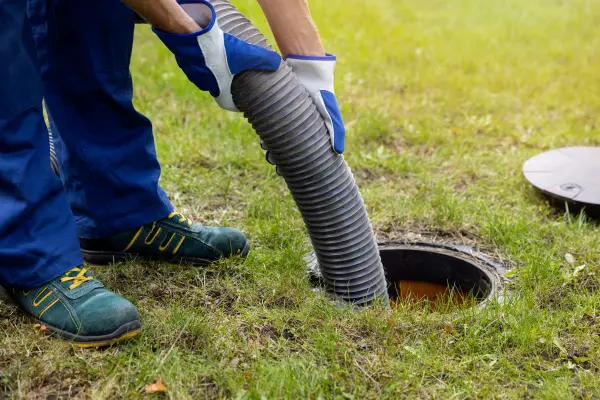
What to expect from a proper pump-out:
- Both tank lids exposed. A tank has an inlet and outlet compartment, each with its own lid. If only one is opened, the tank hasn't been fully serviced.
- The tank washed out, not just drained. The operator should hose down the interior walls and baffles while the vacuum runs, so the tank's condition is actually visible.
- Truck access within about 100 feet of the lids. If the tank is further than that from where a truck can park, arrange it in advance — it affects cost and sometimes feasibility.
⚠️ The most common misconception: a tank sitting full of liquid is not a full tank. A working septic tank is always full to the outlet pipe by design. What determines whether it needs pumping is the depth of the solids on the bottom. Ask the contractor to measure it.
Can't find the tank?
Common on properties where the owner inherited the system and nobody ever marked the lids. For a fee, a septic contractor can flush a tracer down the toilet and follow it with a locator to pinpoint the tank. Worth asking about when you book: if they recover the tracer at the end of the job, the fee is typically reduced.
Once it's located, mark it. A buyer, a future contractor, and your own next pump-out will all thank you.
🔍 The full ROWP inspection
A septic inspection under the regulation is a different job entirely. An Authorized Person locates and exposes the tank and field, assesses the tank, baffles, and distribution box, runs cameras down the lines, evaluates the field for failure, confirms setbacks, and issues a written report.
Combined with a pump-out, expect over $2,000. That's the document a lender, insurer, or buyer's condition can rely on, and on a rural purchase it's cheap relative to the cost of being wrong.
📏 Setbacks — the 100-foot rule
Under BC's Standard Practice Manual, the minimum horizontal setback from a dispersal field to a drinking water well is 30 m (100 ft). From a watertight septic tank to a well, it's 15 m (50 ft). Setbacks are measured from the infiltrative surface — the trench wall — to the nearest edge of the well, and only a Professional can approve a reduction.
This cuts both ways on rural lots: check the distance to the neighbour's well, not just your own. Older systems predating 2005 were built under different rules and don't always comply.
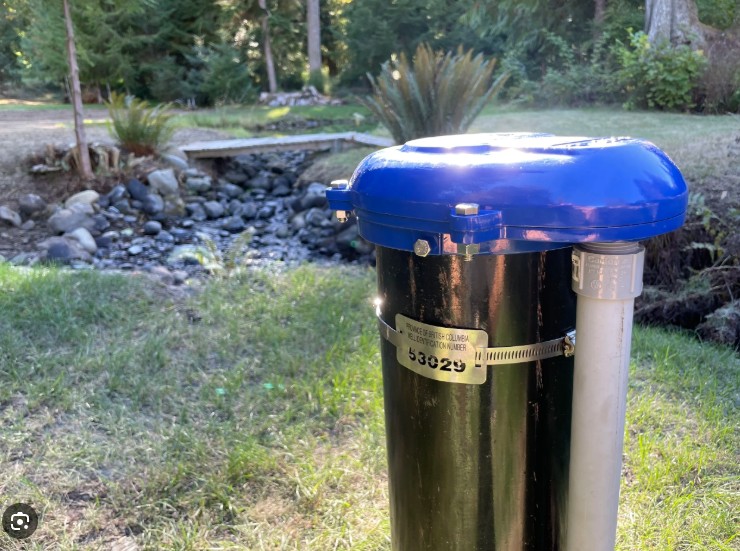
To check whether a well is registered and where it sits, use the province's GWELLS registry at apps.nrs.gov.bc.ca/gwells. It's free and public, and it gives you the well location, depth, construction details, and the driller's log where one was filed. Note that registration wasn't mandatory for older wells, so an absence of a record doesn't mean an absence of a well. For more on wells specifically, see Water Wells — All You Need to Know.
🏡 For sellers
Pump the tank before you list. A recent pump-out is the single cheapest thing you can do to take septic off the table as a buyer concern. It removes the "when was this last serviced?" question entirely, and a buyer who isn't worried about the septic is a buyer negotiating on the house instead of on the unknown. It also means any problem surfaces on your timeline rather than mid-subject-period.
- Pull the Interior Health record now — before listing, not after an offer.
- Pump and inspect at the same time. Tank open is the moment to have a ROWP look at it.
- Put the paperwork in the listing package: pump-out receipts, maintenance records, the as-built drawing, and the maintenance plan if one exists. A buyer who can see the service history doesn't have to assume the worst.
- Answer the Property Disclosure Statement with documentation behind you.
🔑 For buyers
- Write a subject to septic inspection into your offer.
- Request the maintenance records and pump-out receipts along with the Interior Health record. Gaps in the service history are as informative as the records themselves.
- Ask what type the system is (see below), and what the maintenance obligation costs annually.
- Confirm where the tank and field are, and that they're clear of driveways and future building plans.
- Ask how many bedrooms it was designed for — systems are sized by bedroom count.
- On a tight lot, ask whether the system could be replaced in the same footprint if it failed. If not, that's a material risk.
📞 Local septic contractors
Approximate pricing for a pump-out with visual inspection. Confirm rates directly.
⏳ Book early. Through the busy season, lead times run several days to a couple of weeks. On a tight subject period, a septic booking is the first call to make, not the last.
Valhalla Septic Services
778-454-2221 · valhallaseptic@gmail.com
Approx. $800–$900 · Not a ROWP · Typically requires a deposit to book
Beaver Septic (Steven Bengert)
250-354-3508 · a5a57324@telus.net
Approx. $800–$900 · Not a ROWP
All-Around Septic Services Ltd.
250-354-3644 · office 250-359-8282 · allsepticvac@gmail.com
allaroundsepticservices.com · Based in Slocan Park
Typically over $1,000 · ROWP
All three handle routine pumping. Only All-Around can also perform the formal ROWP inspection and issue the report — a separate, larger job at over $2,000 including the pump-out. If you're pumping ahead of a sale and want the report, booking both on the same visit is the efficient way to do it.
One thing worth knowing: All-Around has kept service records since 2005. If a property was serviced by them, that history may be retrievable even when the owner has lost the receipts — a useful call to make when a seller can't find their paperwork.
Verify any practitioner's registration through the ASTTBC registrant directory.
🔢 Reference: the three system types
BC's Sewerage System Regulation classifies onsite systems by how well they treat the effluent.
Type 1 — Septic tank and dispersal field only, gravity-fed or pumped. The standard system, and what most older rural properties have.
Type 2 — Adds secondary treatment, usually a package treatment plant, producing effluent under 45 mg/L suspended solids and 45 mg/L BOD. The cleaner effluent means a smaller field, so Type 2 is common where soil or lot size won't support a Type 1.
Type 3 — Advanced treatment, often with UV disinfection: under 10 mg/L suspended solids, 10 mg/L BOD, and under 400 CFU/100 mL fecal coliform. Used on difficult sites — poor soil, high water table, tight setbacks.
This matters for two practical reasons. Type 2 and 3 systems have mechanical components and require ongoing maintenance by an Authorized Person — a real annual cost the buyer inherits. And a ROWP can only design and build Type 1 and Type 2. Type 3 systems require a Professional Engineer.